Spun out of Mass HVAC in 2019, Q-PAC makes custom Plug-and-Play fan systems for commercial HVAC systems designed for air handling retrofits and OEMs. Its success stems from offering a disruptive product that is delivered and installed quickly. Each fan array is custom-built to customer specifications, with straightforward installation and various features for optimizing facilities.
The company sells its fan systems to office buildings, universities, airports, hospitals, and entertainment venues such as stadiums and arenas. Because each venue has different requirements, Q-PAC developed its own ordering software, QUIPS, which automates the selection and design process according to a customer’s facility operation and space specifications.
“The company operated within Mass HVAC for eight years before being spun out in 2019,” says Kevin Van Dyke, Chief Financial Officer.
“We were incubated inside a company that built air handlers, and we were the fan component,” he says. “We have a very innovative idea of using EC fans and assembling them in a kit-oriented way for new air handlers and retrofit opportunities, allowing us to repair and replace fans in the field.”
Each fan array is shipped as a kit with every component needed to install, assemble, and begin operating in the shortest possible time. With its patent-pending Quick Connect Box and wiring system, installation time has been reduced by 75%. Additionally, its optional BACnet-compatible controller enables a system to operate independently without any field-installed controls.
Q-PAC operates on the principle that “Fan systems should be easy; we are easier.”
“When it comes to the HVAC component we provide, we are probably the fastest in the industry in terms of installation,” says Luis Burgos, Director of Operations. “We offer a simple service: our products are easy to select, install, and service.”
Customers seem to appreciate Q-PAC’s easy-to-install fan systems. “We are averaging around 30% growth,” says Van Dyke. “Actually, it’s been 40% growth since starting as a standalone company. We’ll do close to $32 million this year.”
Difficult to Operate on Spreadsheets
When Q-PAC began operating as a standalone company, it relied on QuickBooks and Excel spreadsheets to manage production and inventory. This approach was tedious, cumbersome, often outdated, and prone to error—anything but efficient for a fast-growing startup.
“We didn’t really know our costs accurately at all,” explains Luis Burgos, Director of Operations. “We didn’t have part numbers, and most visibility on sales orders was through Excel files. Our operations were very task-oriented, and it was extremely difficult to keep track of order statuses. We barely even had part numbers.”
Without part numbers, executives lacked critical insights into inventory and project costs, making it challenging to quote projects accurately. The fragmented, basic systems made it difficult and time-consuming to process engineering changes or assemble bills of materials. Forecasting was also a challenge.
“We would ship something, and at year-end, we could look at the macro view,” says Kurt Thomas, Director of Marketing. “But we had no idea what our individual job gross margins were. With QuickBooks, we couldn’t dive that deep or link all our inventory. Plus, we were using so many different systems and Excel sheets that integrating them just didn’t make sense.”
The difficulty in assessing product profitability was further complicated by the custom nature of Q-PAC’s fans and the range of configurations customers required. To simplify the ordering process for customers, Q-PAC developed its custom software, QUIPS, which automates fan system selection and design based on the client’s specifications. The software covers over 4,000 parts, allowing flexibility and customization.
Q-PAC’s rapid growth, along with the limitations of manual work and disconnected systems, prompted the search for better solutions. “We reached the maximum potential of Excel to run a business,” says Burgos. “We found clever ways of using Excel and macros, but eventually, it just wasn’t sustainable.”
“The order volume was increasing significantly, and we weren’t operating efficiently,” adds Nick Tulip, Director of Technology. “With more orders, we either needed to hire more people or faced challenges scheduling the work.”
Acumatica Manufacturing Edition
Connecting its QUIPS ordering system was Q-PAC’s top priority for a new ERP system. Q-PAC also wanted a cloud-based solution with multi-region support, scalability, and flexibility for customizing unique processes. “We didn’t want to adapt to a tool,” says Luis Burgos, Director of Operations. “We wanted to have a great tool with a good base that we could modify and customize for our use.”
Q-PAC evaluated Microsoft Dynamics, Odoo, and Oracle NetSuite before learning about Acumatica. They narrowed the list to Dynamics and Acumatica, ultimately choosing Acumatica for its unlimited user pricing, open API, and ease of use. Acumatica Manufacturing provided a single source of truth and the flexibility to integrate third-party applications.
“In Acumatica, you could see the integration capabilities that were exposed and available,” says Nick Tulip, Director of Technology. “And it became a no-brainer. Acumatica had some things we hadn’t even considered but realized we might need. The open API was the driving factor for us, and price was a significant factor. Everybody else had a user-per-seat license, which was expensive, but Acumatica offered unlimited users and was transaction-based,” he explains.
Initially, Q-PAC considered being an all-Microsoft shop. However, the enterprise-grade pricing of Dynamics and its complex implementation, which seemed overly complicated for a small startup, led them to reconsider. “I thought it would be an expensive experience, and if we failed to integrate external applications at that cost, it just didn’t make sense,” says Tulip. From a technical perspective, several executives agreed that Acumatica had everything Q-PAC needed to integrate and operate effectively.
“Once I learned more about Acumatica’s structure, the architecture behind the data pages, and how all the data is interconnected, I realized it would be incredibly easy to use and customize. We could view the data we needed and make it accessible for others through various inquiries,” Burgos adds.
Customer Success
As a startup, Q-PAC worked closely with I-Tech Solutions, Inc., its integration partner, to create new workflows. “We needed to set up our customers, business accounts, customer accounts, and other items,” says Tulip.
After everything was configured, Q-PAC moved over two years of data from multiple spreadsheets. “The transition process to Acumatica involved understanding different concepts like sales orders, bills of materials, vendors, inventory, stock items, and non-stock items to configure the endpoints that allowed us to port data over,” Tulip says. “It was actually quite smooth.”
Automated Processes Save Time
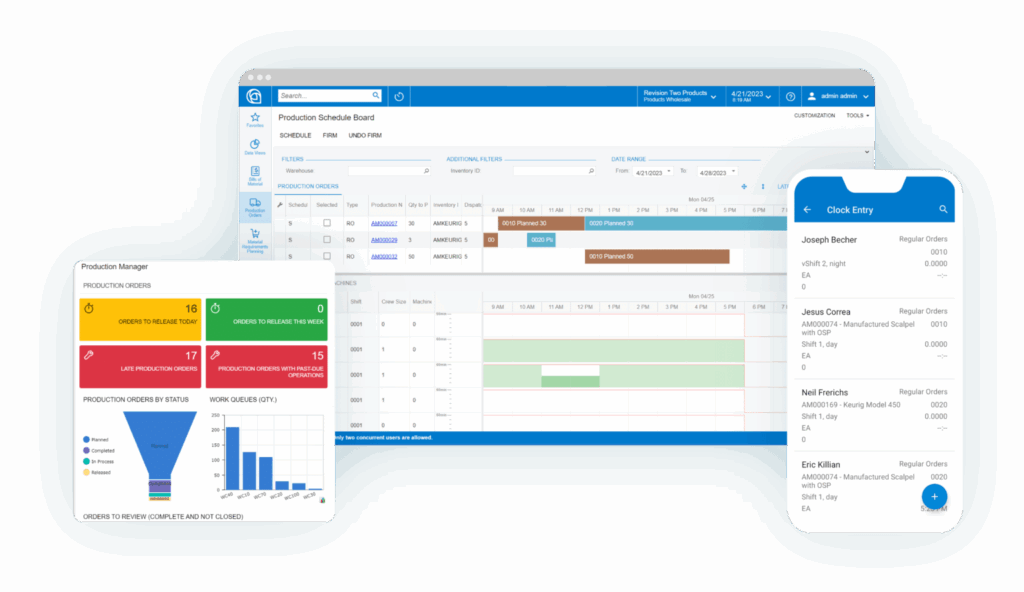
Q-PAC now has instant access to a single record of information that used to take days to locate and compile—if it could even be found among numerous spreadsheets. Reports can now be generated in real-time with accurate data, giving executives a daily view of company performance rather than waiting weeks or months. Faster access to critical information allows Q-PAC to operate more efficiently and quickly adapt to market changes.
“Previously, the information was spread out; nobody knew what the latest information was, and finding it across different Excel files was very challenging,” says Luis Burgos, Director of Operations. “Thanks to Acumatica and our integrations, we get daily reports instantly, and monthly reports just two or three days after month-end. Having access to data anywhere, anytime, is key.” Burgos also appreciates that he can access customized dashboards on his smartphone from any location. “I mainly use it for our dashboard just to know how the week is going and what’s been produced,” he says.
Improved Inventory and Production
Q-PAC now imports design specifications from its QUIPS system directly into Acumatica, which automates the process of creating manufacturing requirements and work orders for subassemblies that ultimately roll up into a final assembly. Acumatica provides visibility so everyone can see whether components are in stock and what capacity is needed for a project. This enables Q-PAC to accurately assess inventory and production costs, helping executives calculate project profitability correctly.
“There are no more Excel files and no more errors,” says Nick Tulip, Director of Technology. “Previously, I had to manually transcribe orders into a spreadsheet and use search features to track order status,” says Randall West, Operations Manager. “Now, I can open a window to check an order’s status without spending 45 minutes searching. We can actually track what we can do now.”
Order status was often just a guess previously. “In terms of personal productivity, Acumatica probably saved me years of my life,” says West. “There’s a lot of time saved in inventory management, and now (the shop floor) has confidence that when they start an order, we’re not stalled for weeks waiting for a part we didn’t realize we needed.”
Acumatica provides the inventory forecasting and management that Q-PAC previously lacked. “We haven’t missed or skipped an order due to running out of components in a long time,” Burgos says.
Piro Zisi, Supply Chain Manager, notes that Acumatica has greatly reduced the time needed to access essential data. “I receive data on vendor on-time delivery, inventory, dollar amounts per item, types based on components, and stock levels, all updated in real-time on a dashboard,” he says. “The data uploads instantly, allowing me to focus on key issues and objectives. Having Acumatica as our ERP system provides real-time visibility across our organization, enabling us to make faster strategic decisions and enhancing collaboration across departments.”
Accurate Bill of Materials
Austin Pleasants, Product Engineering Manager, says Acumatica has given Q-PAC bill of materials (BOM) information they previously didn’t have. “We can now handle different product revisions, ensure production is following the right order, and compare it to the revision to check for differences.”
With Acumatica, design changes happen faster, and BOM is far more accurate. “Every job we handle is different,” Pleasants explains. “Every order has unique dimensions and arrangements, so our BOMs are different for each project. The open API lets us integrate our CPQ with Acumatica, creating a customized BOM for each order and grouping products and stock items as needed to match exactly what the customer wants.”
More Efficient Warehouse
Q-PAC is reorganizing its warehouse with multiple internal locations for item inventory and adding a support section to improve understanding of item use for customer orders and support tickets. Inventory is also being reconfigured to be closer to workstations, reducing the time needed to pick parts.
Additionally, Q-PAC has streamlined its shipping processes, providing the logistics manager with advance production completion data and shipment preparation details. This data is also shared with accounting for timely invoicing.
Alongside QUIPS, Q-PAC integrated Velixo Reports for advanced financial reporting and EBizCharge for credit card processing. The company plans to automate customer notifications for order milestones to boost customer satisfaction and experience.
Fast-Growing Manufacturer
Transitioning from a small operation with simple processes to a standard manufacturer, Q-PAC now fully understands the value of structured workflows, including using part numbers and tracking items from work-in-progress to final stages. “Acumatica has taught us how to operate efficiently and focus on processes that are crucial to success,” says West.
Burgos anticipates that Acumatica will support Q-PAC in ramping up production by five to ten times if necessary. “I don’t think Acumatica will ever be a limitation. Our data visibility is excellent, and we have a scorecard that shows daily, monthly, and year-to-date performance.”
Most importantly, Burgos says, “It makes our life much easier.”